
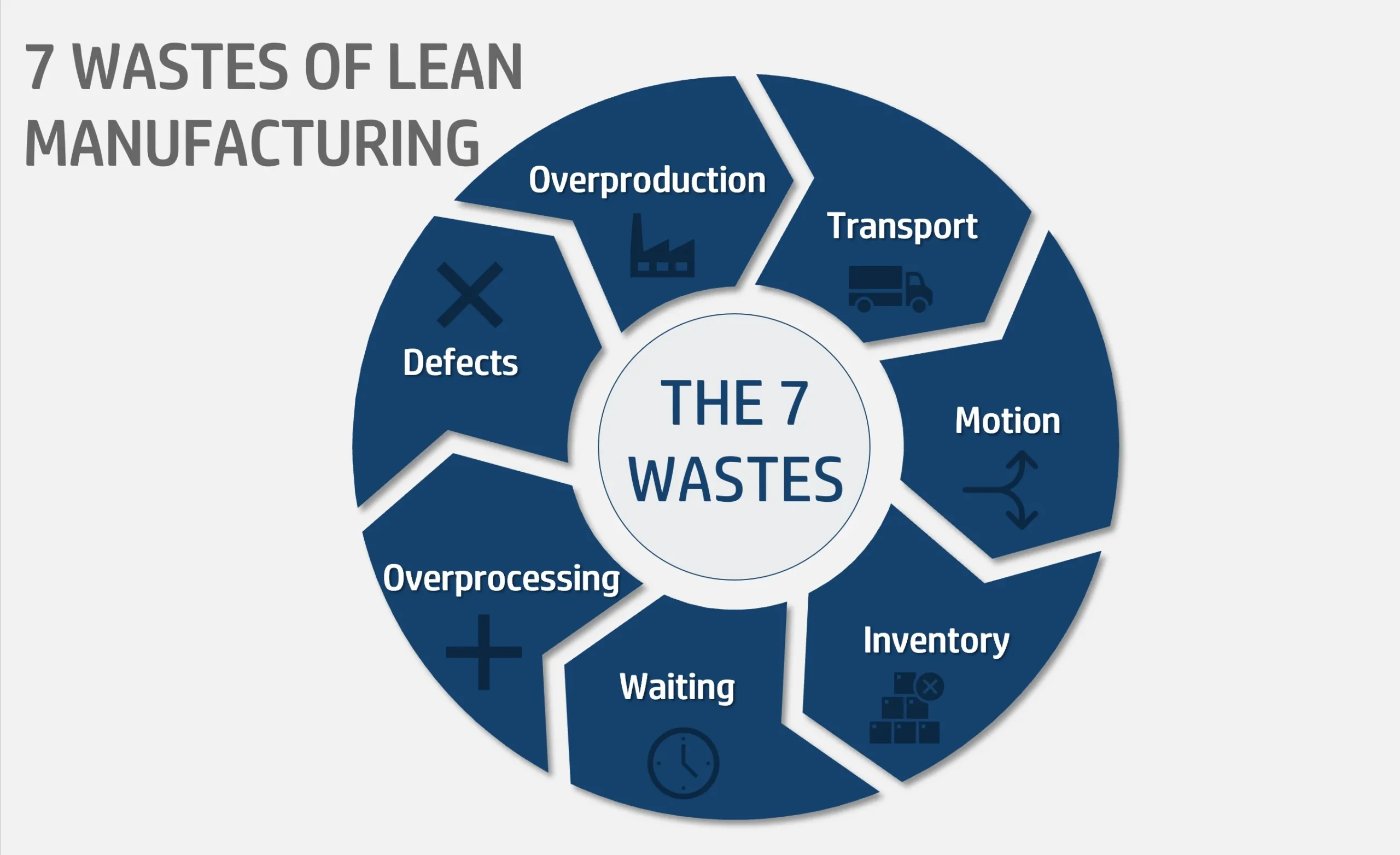
Overproduction
Overproduction means a product, part, or service was produced too fast, at the wrong time, or in too much quantity for the process.
Overproduction is most often associated with tangible outcomes from a process.
For Example
Consider a business that prints and mails for their customers. The printer is capable of delivering 1,000 pages an hour, but the folding machine is only able to fold 800 pages an hour. Even if a customer wants 1,000 pages printed and mailed, the printer is overproducing if the first machine is set to operate at maximum speed. The process will take longer than one hour because is contingent upon the slowest machine – the folding machine. In this situation, rather than running the printing machine at the maximum speed to print 1000 pages per hour, it might be better to run it at slower speed e.g. 800 pages per hour to reduce the machine’s wear and tear.
Overproduction can also be associated with intangible outcomes. With regard to reporting, digital assets, and preparation for processes; almost anyone working in a business environment is familiar with reporting requirements – just as almost anyone who has created reports knows the unfortunate truth that the information often goes unread. Creating reports no one reads – or creating highly detailed reports when an overview would suffice – is overproduction.
The key to eliminating overproduction is planning. In the example above, when the owners know how many orders were likely, they were able to plan to reduce waste. When the printer knows the capability of each machine in the process, he or she can plan for the most efficient printing run.
Correction
Also known as muda of rework, this form of waste often plagues organizations that are keen on traditional quality programs. In a desire to eliminate defects from the end product, organizations Institute in-process quality checks that route work with defects back for correction.
When rework occurs, it increases overall process time and uses additional labor and materials to create a smaller amount of products or outputs.
Correction, or rework, can occur in any type of process. Manufacturing processes cull out defective parts and products; sometimes materials are reworked for a better outcome and sometimes they are scrapped-also a form of waste. Call centers and digital work queues are famous for rework, as it’s easy to send work back and forth in a digital format. In some cases, rework occurs not because of correction, but simply because departmental or worker responsibilities overlap.
To eliminate rework or correction, organizations must use a twofold approach:
- Find the he root cause of the rework – that which is causing the errors. Is further employee training required? Could a process be changed to make it more mistake proof?
- Create quality steps that reduce rework waste. Can the rework processes be streamlined? Are the KPIs or goal-metrics set at the right level of the process?
Inventory
Muda of inventory occurs when materials or inputs stack up before a step in the process; this phenomenon is also called a bottleneck.
Inventory waste can occur when items are purchased or created before they are needed in a process. Inventory can also occur in work queues, digital data queues, or even email inboxes. If you receive 300 emails a day and you are only handling 30
of them on a regular basis, you have a process problem with your communications.
While inventory waste can occur in any process, it is especially common in processes that operate in batches. Traditional lean wisdom says to avoid batch process – processes that involve creating a certain number of products or outputs before pushing them down the line. Reducing batch size lowers lead times-the time it takes to deliver the end product. It also reduces the amount of inventory that occurs before each step of the process.
You can reduce waste of inventory by understanding a process and basing inventory decisions on historic metrics.
Motion
Muda of motion has to do with how employees themselves move during a process. This type of waste is often relevant to people-powered processes in manufacturing, warehousing, shipping, delivery, or industrial fields, but waste of motion can even crop up in processes that are computerized.
For example, if a data-entry employee has to click back and forth between screens when entering information, this could be muda of motion. If the system is designed so that a number is to be entered in one window and a second number entered in a different window, the click between windows is wasting motion.
Other examples of muda of motion include a task that requires an individual to physically move back and forth between work, extra motion that stems from a poor layout of work, or movement that occurs when an employee leaves an area and has to return one or more times because he or she forgot something.
Streamlining company processes eliminates muda of motion, and data must be collected and analyzed to identify unnecessary movement.
A common tool used in manufacturing and similar environments to track movement is known as a spaghetti diagram, Begin with a basic, bird’s eye drawing of the workspace. Include furniture, computer stations, machinery doors, and walls. Observe an actual process, tracking any and all movements with a line on the diagram. The diagram looks like a string of spaghetti fell onto your page. Once the process is complete, you can look at the diagram to see where the movements cross paths multiple times or go out of the way unnecessarily. This helps you find opportunities for streamlining the movement in a process
Conveyance
Muda of conveyance Is similar to muda of movement except conveyance involves the movement of outputs, products, or resources, It is sometimes also referred to as muda of transportation.
If an expense report is printed and then carried to a manager for approval who then routes it in an inner-office envelope to a director, who then carries it to the accounting department, the muda of conveyance is occurring.
Conveyance can relate to physical movement of items or digital movement of data or workflow. Email strings, which are present in many work environments, often present muda of digital conveyance. A CEO might email a director with a request for data. The director emails a manager, who emails a supervisor, who emails a subject-matter-expert. The SME delivers the information to her supervisor, and the emails work their way back up the chain. The same request and information was conveyed multiple times when it only may have needed to be conveyed once. This allows for many opportunities for error.
Once you identify muda of conveyance, you can eliminate it by making changes in the process, layout, or inventory requirements for the work. If conveyance waste isn’t due to poor process design or work-area layout, it might be related to another form of muda.
Conveyance is often seen in processes that involve a lot of correction, because work is transferred back and forth between staff or areas. By addressing the muda of correction, you often also address the muda of conveyance.
Over-processing
Over-processing occurs when an employee or process inputs more resources into a product or service than is valued by the customer. Sometimes over-processing occurs because an employee hasn’t had training on the most efficient way to handle a task. Other times, it occurs because an employee or process is more thorough than is worthwhile.
A goal of any process should be to do just enough useful and necessary work to ensure that customer or end-user expectations are met.
Example
Over-processing often occurs in healthcare administrative offices during the insurance verification process. Insurance verification occurs when a healthcare providers office attempts to verify that a person is covered by insurance for the services that are about to be rendered. Depending on the type of insurance coverage and the office’s policies, a staff member either checks benefits via a computer program or calls the insurance company.
In most cases, the goal of insurance verification is simply to ensure that the insured is covered by the plan for the date the services are to be rendered. Sometimes, however, an office worker delves deeper into the verification, spending up to an hour on the phone with an insurance company to receive detailed benefits or calling back to check with another representative to ensure the original information provided was correct. While specific cases exist that require in-depth insurance verification, basic doctor’s visits don’t require this level of work. A staff member who is taking up to an hour to verify insurance coverage is overprocessing,
A value stream map is a good tool for identifying any points of over-processing. Any part of the process that doesn’t provide value could be considered over-processing; when the process features a series of linked events and none provide value, it’s even more likely that over-processing is occurring.
Waiting
Muda of waiting refers to any idle time in a process, it could be the case of an employee or machine is working below capacity or is not working at all due to waiting on inputs from another part of the process.
Waiting occurs when steps in the process are not properly coordinated, when processes are unreliable, when work is batched too large, during rework, and during long changeovers between staff or machines.
For example, some offices have policies requiring an official IT staff member to handle any computer issue. Whether it’s a software glitch, a troubleshooting error, or simply the need to switch out an underperforming mouse, regular office staff must send a support ticket or make a phone call and wait for IT staff to solve the problem.
You can eliminate waste of waiting within many processes by balancing machinery, people and production. Scheduling is a key component in eliminating waiting.
In the IT example above, a company can reduce wait times by maximizing IT staffing at high-volume times or implementing processes within the IT department to create more efficient responses to help tickets. An auxiliary IT staff member can be hired to handle less technical issues such as switching out an under-performing mouse