
Step 1: Create Swim Lanes
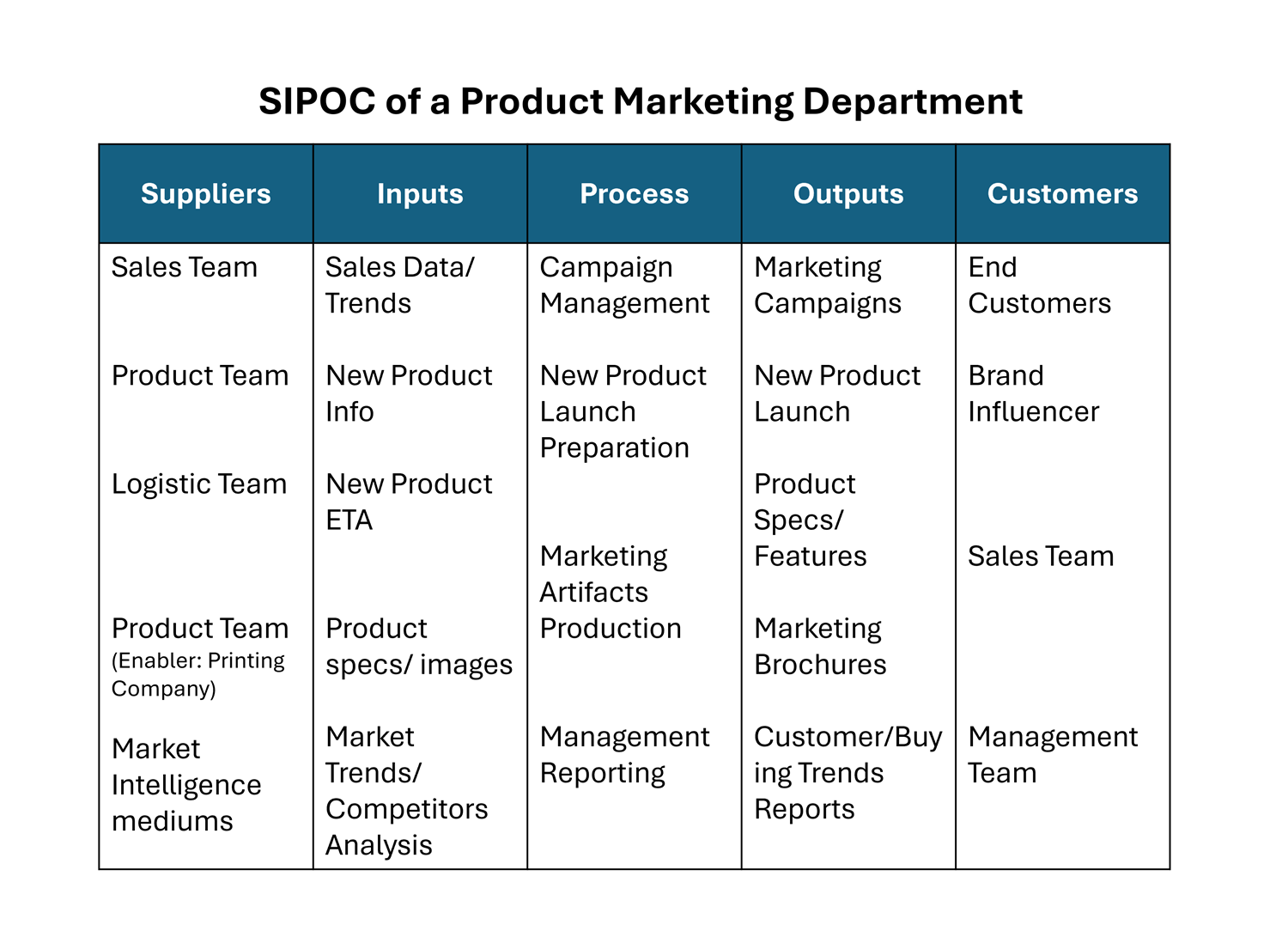
A SIPOC diagram is based on swim lanes. Swim lanes let you know how cross-functional activities and resources relate to your processes. A SIPOC diagram has five lanes: Suppliers, Inputs, Process, Outputs, Customers.
Step 2: Set Boundaries and Name Your Process
It is important to set a definition of where the process and responsibility of the SIPOC diagram begins and ends. If the scope is not defined, the SIPOC session can get out of hand and not producing the outputs that are meaningful.
For the example given above, the scope for the SIPOC exercise is defined to be for the Product Marketing Department of a company.
Step3: Complete Swim Lanes
The SIPOC swim lanes can be completed in any order. It is normally recommended the data be entered in the following order:
- Process
- Outputs
- Customers
- Inputs
- Suppliers
Having said that, if we look at the example above, for a Marketing Department, they might be more familiar with the Outputs that they need to produce for different Customers for the different events; it might be easier to fill the Outputs and Customers lanes first, and from there they can work out what are the Processes involved and where do the Inputs and Suppliers come from.
A SIPOC is usually meant for high level processes, it is recommended to just enter the name of the process; the detail process steps are not involved at this stage.
In the example above, the processes are kept at high level e.g. Campaign Management, New Product Launch Preparation. A more detail SIPOC may be required for each of this process in order to investigate the potential issues that can only be uncovered under the fold.
Step 4: Validate the information
Ensure that the understanding of the process at this high level is accurate by validating the SIPOC diagram with Subject Matter Experts (SMEs) for the area. It is also a good practice to get a second opinion from other SMEs or Process Owners to understand if there is any process that they might assume is provided by the area of focus.